Bitcoin Pizza Day: The $1 Billion Slice of Crypto History
The Historic Transaction
The story began on May 18, 2010, when Hanyecz posted on the Bitcointalk forum offering 10,000 bitcoins to anyone willing to order him two large pizzas. Four days later, Jeremy Sturdivant (known online as “jercos”) accepted the offer, ordering the pizzas with his credit card and receiving the 10,000 BTC transfer in return. At the time, 1 BTC was worth roughly $0.0041.
In a 2019 interview with 60 Minutes, Hanyecz explained his motivation:
“I just honestly thought it would be really cool if I could say hey, I just traded this open-source internet money for a real-world good”
He remains unbothered by the trade’s current valuation, noting that at the time, “bitcoins had no value,” so exchanging them for pizza “was incredibly cool”.
Why It Matters Beyond the Price Tag
Critics often focus on the “lost” billions, but Bitcoin Pizza Day represents something more profound than a cautionary tale. As Naomi Brockwell noted in her documentary analysis, the exchange “grounded Bitcoin’s price in terms of real-world goods for the first time ever” and became “a catalyst for greater adoption”. It proved that peer-to-peer, permissionless digital currency could bridge the gap between abstract mathematics and everyday commerce. Hanyecz himself wasn’t sure he priced the offer correctly. After three days with no takers, he asked the forum:
“Is the bitcoin amount I’m offering too low?”
Bitcoin’s Price Evolution on May 22
From $162 in 2015 to over $110,000 in 2025, the exponential trajectory illustrates Bitcoin’s remarkable adoption curve. The year-over-year growth reveals a distinct pattern.
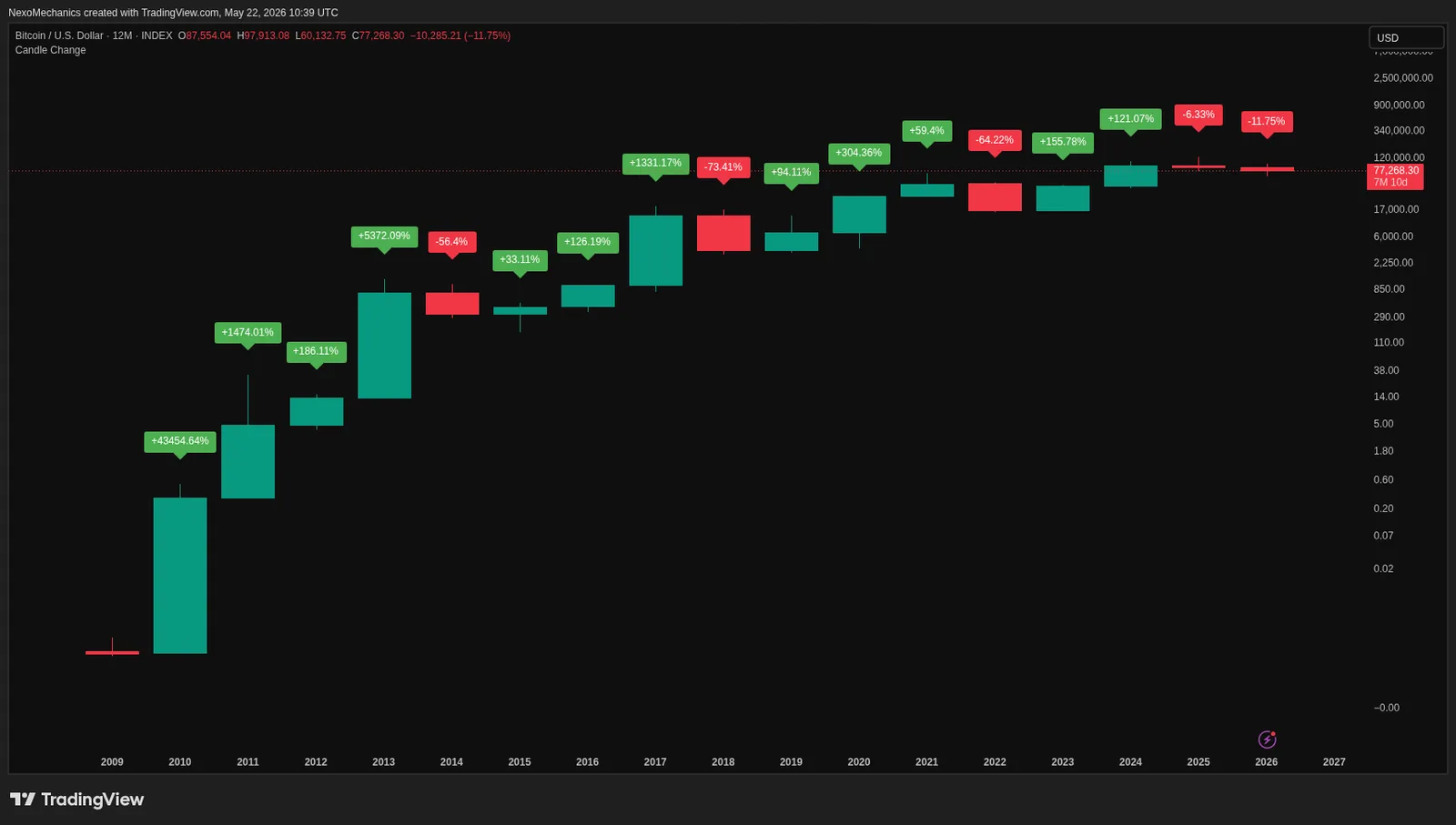
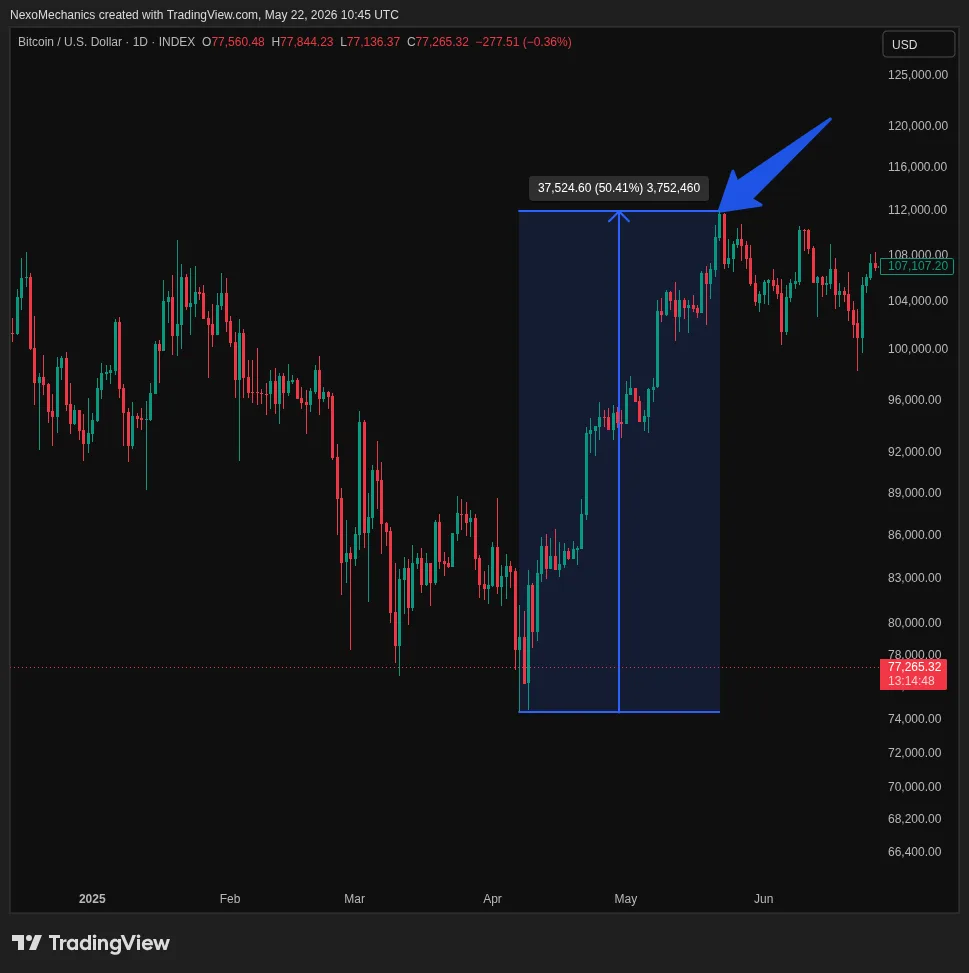
Post-halving years (2016, 2020, 2024) consistently show outsized gains, while bear market years (2014, 2018, 2022) produce negative or muted returns. On May 22, 2025, Bitcoin closed at a local all-time high of $111,965, demonstrating that Pizza Day can coincide with significant market moments rather than merely nostalgic ones.
Pizza Day Seasonality
TradingView Indicator
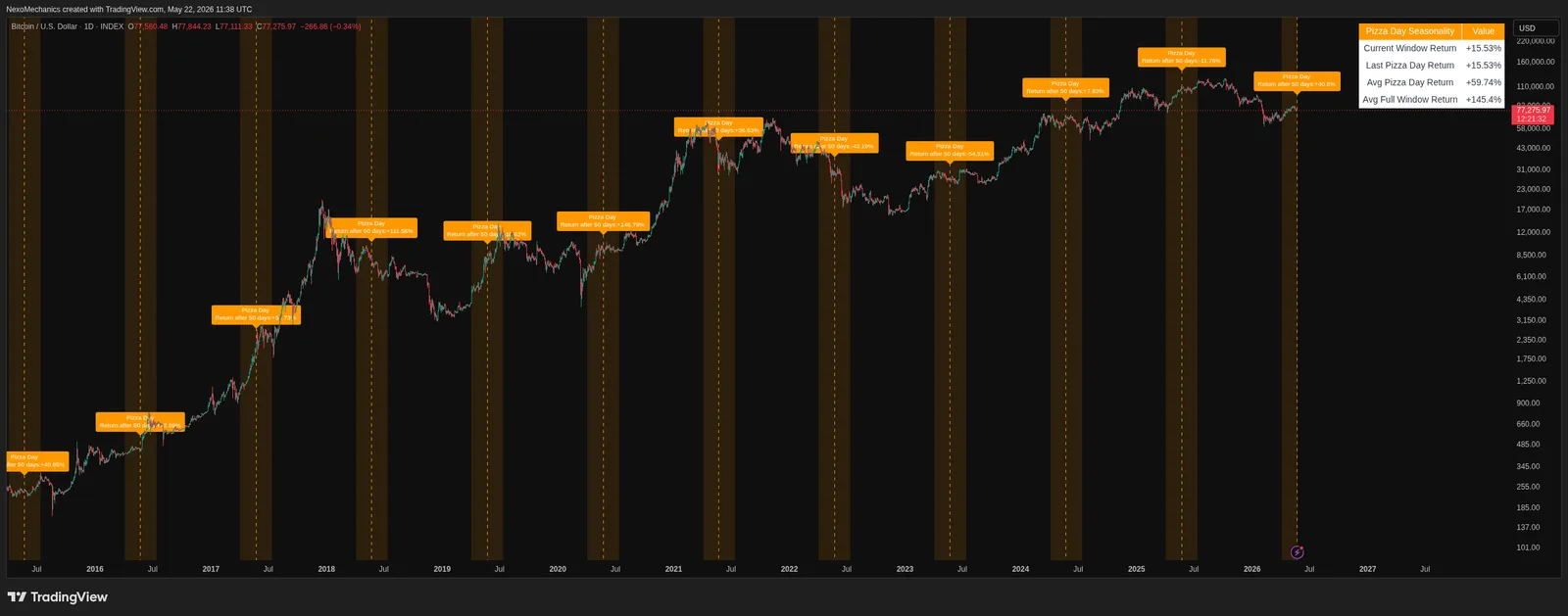
This TradingView indicator analyzes price action around Bitcoin Pizza Day. The Pizza Day Seasonality indicator identifies May 22 automatically using day-of-year calculations and computes rolling returns relative to each historical Pizza Day price.
Algorithmic Insights
The data reveals that the seasonal window around May 22 carries a potentially quantifiable edge: the average 50-day return following Pizza Day is +59.74%, with a full-window average of +145.4%. However, the distribution is heavily right-skewed. Four years posted returns above +100%, while four bear-market years produced losses of -10% to -54%. A regime-aware implementation that only takes the signal when price trades above the 200-day moving average would likely shift the win rate from roughly 67% to well above 80%, filtering out the drawdowns.
Another striking detail is what happened immediately after the first Bitcoin Pizza Day. On TradingView’s historical BTC chart, Bitcoin surged roughly 1,868% in the 55 days after May 22, 2010. That explosive move highlights how early Bitcoin was still in its price-discovery phase. Liquidity was thin, valuation was highly unstable, and even a small increase in attention could trigger extraordinary percentage gains. In other words, Pizza Day did not just mark Bitcoin’s first real-world purchase; it also sat near the beginning of its first major speculative repricing.
Limitations: Seasonality indicators should never be used in isolation. Bitcoin’s market data is still relatively small for robust statistical inference, and macro conditions. Also, monetary policy, and regulatory shifts, and as of recent, BTC ETF flows, often overwhelm calendar effects.