Model Context Protocols for Trading: Is the hype justified?
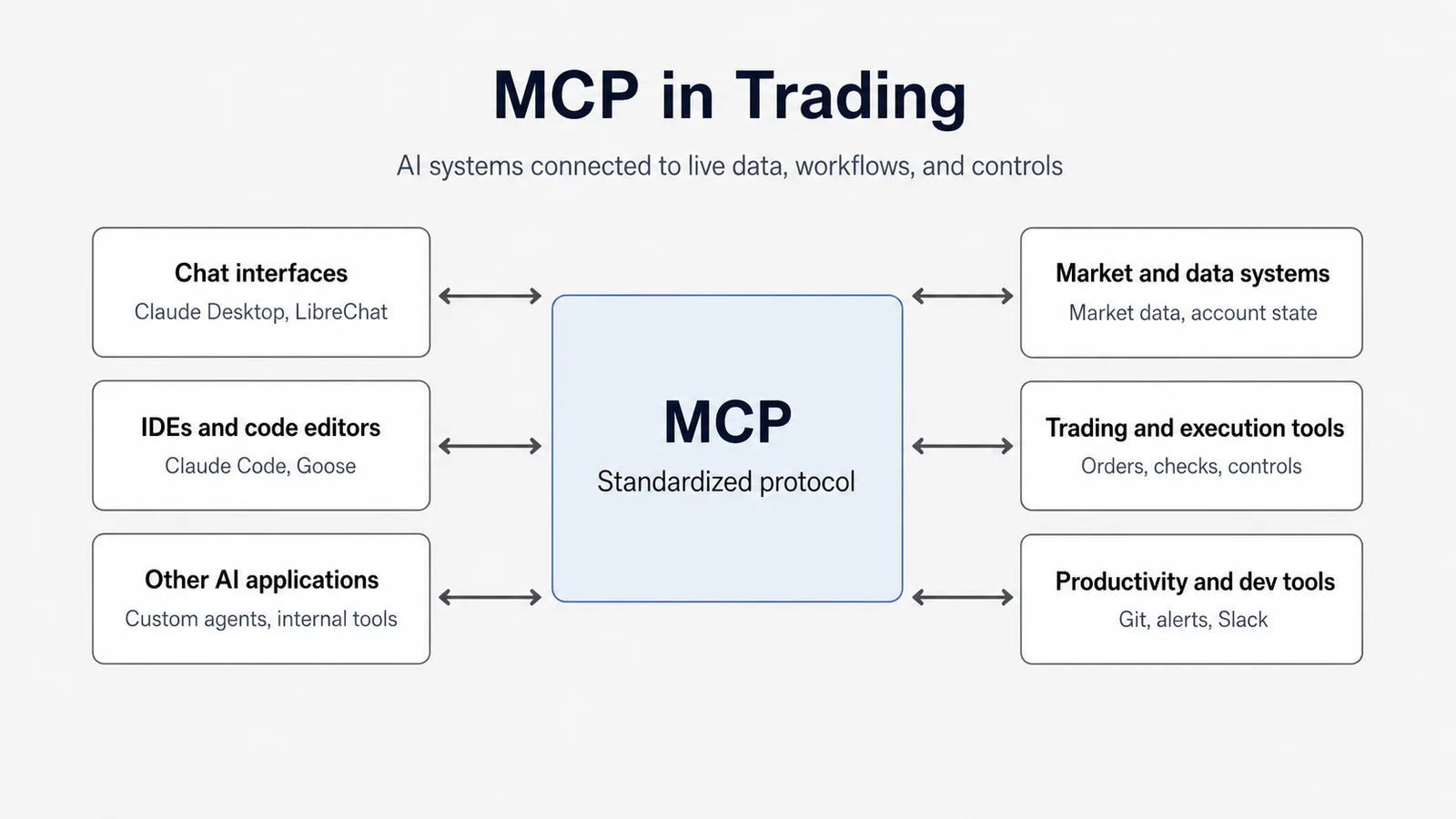
Model Context Protocol is increasingly being discussed as a standard way for AI systems to connect to software tools. In trading applications, that conversation is especially relevant because the value of AI depends heavily on access to live data, workflows, and controls rather than on language generation alone.
The interest in MCP is not purely theoretical. There are already public implementations on GitHub that focus on financial datasets, stock analysis, broker connectivity, and trading workflows. Financial services vendors are also positioning MCP as a way to expose internal systems and licensed content to AI in a more structured and governable way. That combination suggests the protocol is moving beyond concept and into real product experimentation.
What is MCP
MCP is a standardized interface layer that helps AI systems interact with existing software tools in a structured way. That basically means it functions like an API layer on top of APIs that already exist, making it easier for AI to discover, interpret, and use existing tools.
Trading Automation
Trading applications already operate in a highly automated environment. Pre-trade checks, conditional order logic, execution controls, entitlement management, alerting systems, and internal policy rules are standard parts of modern market infrastructure. For that reason, the core question is not whether trading needs automation. It already has it. The more relevant question is whether MCP provides a better way to connect AI assistants to those existing automated systems.
That distinction matters because most current automation is rule-based. A rule-based system can follow predefined instructions and enforce them when specific conditions are met. It is effective precisely because it is narrow, predictable, and testable. But that same structure also limits how much context it can handle. It does not naturally allow an AI assistant to explore tools, retrieve information from multiple systems, or adapt its sequence of actions to a user request within a governed framework.
For that reason, a rule-based tool can solve only part of the problem. It can automate fixed actions, but it cannot easily give an AI system broad, structured access to the operating context in which trading decisions are made. MCP is potentially important because it treats this as an interface problem. Instead of hardwiring every AI interaction separately, it offers a way for AI systems to discover and use tools in a dynamic way.
The Value of MCP
MCP should not be understood as a replacement for trading strategy, execution engines, or risk systems. It is better understood as a coordination layer that sits above those systems and makes them accessible to AI assistants in a more consistent way. If that model proves effective, the benefit is not that AI becomes fully autonomous. The benefit is that AI can interact with complex trading environments through governed pathways instead of brittle custom connections.
That is especially relevant because trading workflows are rarely confined to a single application. A useful assistant may need to inspect data and prepare or initiate an action. In many applications, those capabilities already exist, but they are spread across many systems. MCP offers a way to expose those systems in a shared format so that AI can work across them more coherently.
The practical appeal is straightforward. A trading platform does not necessarily need to build an entirely new execution stack to experiment with AI. It needs a reliable method for allowing AI systems to read from existing infrastructure and act within clearly defined permissions. That makes MCP attractive because it lowers the integration cost of adding AI to environments that are already heavily automated.
Current Market Signals
The strongest sign of momentum is the appearance of public projects built around financial and trading use cases. GitHub already includes MCP-oriented projects for stock traders, broker APIs, TradingView market analysis, NinjaTrader connectivity, and MetaTrader integrations, alongside broader directories listing finance and trading MCP servers. That does not mean the ecosystem is mature, but it does show that developers see trading as a meaningful use case for the protocol.
It is also notable that these projects are not all aimed at the same problem. Some are focused on market data and research. Others are aimed at broker connectivity or order execution. Some are designed for general-purpose AI clients such as Claude Desktop or developer tools that can attach MCP servers as extensions to an assistant workflow. This variety suggests that the value of MCP in trading may not come from a single universal platform, but from a growing layer of interoperable tool connectors around the trading stack.
Even so, the landscape remains fragmented. There is no widely adopted, comprehensive any-to-any MCP layer that seamlessly connects every platform to every other platform. Instead, the market is developing through platform-specific connectors and narrow integrations. In the near term, that likely means MCP adoption in trading will advance through targeted use cases rather than through a single dominant standard implementation.
Limits and Realistic Use Cases
This is also where the limits become clear. In trading, access is only one part of the problem. Any AI-connected workflow must still satisfy various lines of accountability. A protocol can standardize how AI connects to tools, but it does not by itself solve governance.
The most credible near-term applications are likely to be narrow and supervised. An AI assistant may retrieve account information and help a user navigate internal systems. More sensitive actions, such as live order submission or strategy modification, are likely to remain constrained by permissions, approval layers, and existing execution controls.
Public repositories and early pilots can show that MCP-based trading connections are technically possible. Production deployment is a higher threshold. In financial environments, the issue is not simply whether AI can connect to tools. It is whether that connection can operate safely inside the standards expected of trading infrastructure.
The strongest case for MCP in trading, then, is not that it introduces automation where none existed before. Trading systems are already full of automation. The stronger argument is that it may provide a more standard way to connect AI to those systems, especially where context, tool access, and workflow orchestration matter more than language generation alone. If the protocol continues to mature, MCP will likely become a useful interface layer for AI-enabled trading applications, even while the underlying trading logic remains rule-based, model-driven, and tightly controlled.